Biography
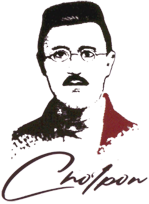
ABDULHAMID SULAYMON OGLI — CHOLPON
(1897–1938)
Abdulhamid Sulaymon ogli Cholpon was born in 1897 in the Qatorterak district (now Navoiy Shah Street) of Andijan city, into the family of the merchant-bazzaz Sulaymonqul Muhammadyunus ogli (1874–1929).
Cho'lpon's ancestors were from Yorqishloq in the Xo'jaobod district of the Andijan region, where they were known to have been engaged in farming. His grandfather, Muhammadyunus Oxund, moved to Andijan city in the early 1870s, purchased a house at the aforementioned address, and settled there. According to the latest identified information, Muhammadyunus Oxund was a religious scholar who worked as a teacher (mudarris) for many years at the prestigious Kholbek Qushbegi Madrasa — one of the city's respected educational institutions — and died in 1905. Thus, the spiritual atmosphere in the family was favorable, and all of Muhammadyunus Oxund's children grew up to become enlightened people of their time. In particular, Sulaymonqul also studied at a madrasa for many years and became well-versed in religious sciences, so much so that the townspeople respectfully called him "Mulla Sulaymonqul Oxund." Additionally, numerous sources preserved in the treasury of the Andijan Regional State History and Culture Museum, especially a 300-page handwritten notebook containing his personal library of over 100 rare works and literary heritage, attest to his high scholarly competence and creative abilities.
Cho'lpon received his early education in a traditional maktab (old-style school). As the eldest and only son among four children, Abdulhamid's education and upbringing were given serious attention from a very young age. After learning to read and write, his father hired private tutors to ensure he mastered all the necessary sciences of the time, and provided for his material needs without any hardship.
At the time when Cho'lpon began his studies, there were several religious madrasas operating in Andijan. Although he himself later recalled studying at a madrasa, there is no exact information about when and at which madrasa he studied.
Abdulhamid Cho'lpon, in accordance with the demands of his era, first acquired solid religious knowledge, learned Arabic and Persian, and also studied necessary secular subjects from Turkish and Tatar teachers, particularly mathematics, including perfecting his Russian. According to the recollections of some contemporaries, he studied at a Russian-native school, but there is no documented evidence of exactly when and at which school he studied.
In 1914–1915, Cho'lpon collaborated with the newspapers "Sadoi Turkiston" and "Sadoi Farg'ona." In 1916–1917, he worked in the editorial office of the "Turkestanskiy golos" newspaper published in Andijan. In mid-1917, he served as director of the Muslim reading room opened in Andijan's Old City. In 1918–1919, he was engaged in teaching activities. In 1919, he worked at the Andijan District Education Department, at the Fergana Province Turkish Teachers' Courses, and in the editorial office of the "Yangi Sharq" newspaper published in Fergana city.
In 1919–1921, he served as head of the Tashkent Old City branch of the Russian Telegraph Agency (ROSTA) and simultaneously as editor of the Uzbek wall newspaper "Ro'sTO." In the summer of 1920, he was head of ROSTA's Andijan Old City branch and responsible editor of the newspaper, while also teaching at a six-month teacher preparation course. In 1920, he served as director of the "Turan" Theater in Tashkent and as chairman of the Scientific Council under the People's Commissariat of Education.
From May 1921 to June 1922, at the invitation of the leadership of the Bukharan People's Soviet Republic, he went to Bukhara and served as responsible editor of the government newspaper "Buxoro axbori" and for some time as director of the Bukhara Republic State Publishing House.
In 1922, he actively worked at the "Inqilob" journal and the "Turkiston" newspaper. In 1922, his first poetry collections "Uyg'onish" (Awakening) and "Buloqlar" (Springs) were published.
From May 1923, he worked at the "Darxon" newspaper established in Andijan; after the newspaper ceased publication in late August, he worked at the Andijan District Military-Revolutionary Committee and from October at the "Vaqf" department. In October 1923, he married a girl named Soliha. In December of that year, he went to Kokand and worked as a literary employee and correspondent for the "Farg'ona" newspaper. During 1924–25, he worked as a correspondent for the "Farg'ona," "Turkiston," and "Qizil O'zbekiston" newspapers.
In 1926, the poetry collection "Tong sirlari" (Secrets of Dawn) and the textbook-collection "Adabiyot parchalari" (Pieces of Literature), co-authored with Ashurali Zohiriy, were published.
In 1926–1927, Cho'lpon worked in Moscow as a translator and literary employee at the first Uzbek drama studio established under the Bukhara Education House. In 1927–1931, he worked as a literary collaborator with the Uzbek State Theater troupe in Samarkand. In 1927–1928, he worked as a correspondent for the "Zarafshon" newspaper.
In 1931–1934, he worked as a translator at the Council of People's Commissars of the USSR in Moscow. In mid-1934, he returned to Tashkent and worked as a literary collaborator at the Hamza Theater and as a literary employee at the "Mushtum" and "Guliston" journals. In 1935, the poetry collection "Soz" (Melody) was published, and in 1936, the novel "Kecha va kunduz" (Night and Day) was printed.
Abdulhamid Cho'lpon was arrested on July 13, 1937, and shot on October 4, 1938, as an "enemy of the people." He was rehabilitated in 1957.
He was posthumously awarded the State Prize named after Alisher Navoi in 1991 and the Order of Independence in 1999. The 100th anniversary of the poet's birth was widely celebrated at the republic level in 1997.
Muhim Sanalar
Cho'lponning tavallud topishi
Andijon shahrining Qatorterak (hozirda Navoiy shoh ko‘chasi) mahallasida tavallud topdi